

Warehouse vs. Inventory Management: WMS vs. IMS Decision Guide
Inventory Management tells you what you have, how much you need, and when to reorder. Warehouse Management tells you where it is, how to move it, and how to ship it fast. One looks across your entire supply chain; the other looks deep inside your facility. Most sellers confuse them — and that confusion costs them money, speed, and customer trust.
Table of Contents
- Why Most Brands Confuse WMS and IMS (And Pay the Price)
- Key Differences Between Warehouse Management System and Inventory Management
- Inventory Management Explained: The "What & When" System
- Warehouse Management Explained: The "Where & How" System
- Where They Overlap — and Where They Must Work Together
- Red Flags That You Need WMS (Not Just IMS)
- Red Flags That You Need IMS (Not Just WMS)
- How ChinaDivision Closes the Gap?
- FAQs: About Warehouse Management & Inventory Management
- Recommended Industry Resources
From our perspective operating global fulfillment centers, the biggest mistake growing brands make: using one without the other. Inventory without warehouse data = blind spots. Warehouse without inventory planning = waste.
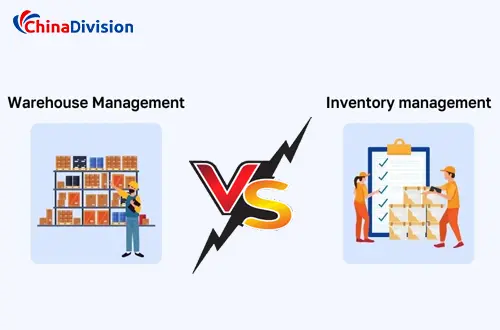
For international e‑commerce and B2B brands, understanding the difference between inventory management and warehouse management isn’t just academic—it’s the foundation for scaling efficiently. Inventory management answers “What do I have?” while warehouse management answers “Where is it, and how do I move it?” Together, they form the backbone of modern fulfillment. This guide clarifies the difference, shows exactly how they integrate, and reveals why top sellers combine both systems.
Why Most Brands Confuse WMS and IMS (And Pay the Price)
Warehouse management and inventory management are often used interchangeably—but they are fundamentally different systems with distinct purposes. Confusing them leads to costly mistakes: overselling, stockouts, inefficient picking routes, and delayed shipments.
- Inventory Management (IMS) answers: "What do I have, where is it in the supply chain, and when do I need to reorder?"
- Warehouse Management (WMS) answers: "Where exactly is each SKU in the warehouse, how do I pick it fastest, and how do I ship it accurately?"
Key Differences Between Warehouse Management System and Inventory Management
| Factor | Inventory Management System (IMS) | Warehouse Management System (WMS) |
|---|---|---|
| Primary Question | "What do I have and when do I need more?" | "Where is it and how do I ship it?" |
| Scope | Entire supply chain — suppliers → warehouses → sales channels | Inside one facility — receiving → storage → picking → shipping |
| Focus | Quantities, timing, value, forecasting | Locations, routes, labor, efficiency |
| Key Metrics | Turnover rate, stockout rate, holding cost | Order processing time, picking accuracy, space utilization |
| Reorder Logic | ✅ Calculates reorder points & forecasts demand | ❌ Does not decide when to buy |
| Location Tracking | ✅ Which warehouse has stock | ✅ Exact shelf/bin coordinate |
| Picking & Packing | ❌ Not involved | ✅ Optimized routes, labels, workflow |
| Inbound Receiving | ✅ Expected quantity & arrival date | ✅ Unload, count, quality check, putaway |
| Multi-Warehouse | ✅ Quantity across all locations | ✅ Operations inside each location |
| Complexity | Moderate — data & forecasting | High — operations, automation, labor |
| Cost Impact | Prevent overstock & stockout → save capital | Faster + fewer errors → save labor & shipping |
| Best At Scale | Always essential | Needed above ~200 orders/month |
Inventory Management Explained: The "What & When" System
Inventory Management is your supply chain command center. It looks at your business globally — across suppliers, warehouses, sales channels, and time.
What It Does
- Tracks stock levels across all locations and channels
- Sets reorder points and calculates economic order quantity (EOQ)
- Forecasts demand based on sales history, seasonality, and trends
- Prevents overselling and stockouts across Amazon, Shopify, eBay, etc.
- Values inventory, tracks costs, and manages turnover
- Plans replenishment lead times from suppliers
Why It Matters for Ecommerce
- Stockout = lost sale + disappointed customer
- Overstock = dead capital + rising storage fees
- Cross-border = longer lead times → forecasting becomes critical
- Multi-channel = need single source of truth for inventory quantity
Limitations
- Knows which warehouse has stock — but not which shelf
- Knows when orders ship — but not how long picking takes
- Cannot optimize labor, routes, or packaging
Warehouse Management Explained: The "Where & How" System
Warehouse Management is your facility operations engine. It focuses on physical reality — inside the four walls.
What It Does
- Inbound receiving: Unload, verify, label, and putaway
- Location mapping: Exact shelf, bin, or pallet position
- Picking optimization: Shortest route, batch picking, wave picking
- Packing & shipping: Box selection, weighing, labeling, documentation
- Task assignment: Who does what, in what order
- Real-time accuracy: Scan → confirm → update instantly
Why It Matters for Fulfillment
- Fast picking = shorter "click-to-ship" time
- Barcode/RFID scanning = 99.9% accuracy vs 92% manual
- Optimized packaging = lower DIM weight = 15–25% freight savings
- Peak season capacity = system guides efficiency, not just hiring more hands
Limitations
- Optimizes operations — but doesn't know why stock arrived
- Shows current location — but doesn't forecast when it will run out
- Cannot tell you which products to buy or stop selling
Where They Overlap — and Where They Must Work Together
Common Goals
Both systems share the same ultimate purpose: Get the right product to the right customer at the right time, at the lowest cost. Both use barcode/RFID scanning, both integrate with platforms, both provide real-time data.
The Integration Point — Where Magic Happens
Order ships → WMS confirms → IMS deducts inventory instantly → all sales channels update → replenishment trigger recalculates
Without this loop:
- ❌ Quantity shows available but already picked → oversell
- ❌ Reorder points trigger late → stockout
- ❌ Receipts not logged → IMS plans shipment → empty shelf
With proper integration:
- ✅ Inventory updates the moment items are scanned
- ✅ Sales channels sync instantly → zero overselling
- ✅ Replenishment sees actual consumption → accurate orders
- ✅ Lead times measured automatically → better forecasting
Red Flags That You Need WMS (Not Just IMS)
- Pickers spend more than 5% of their time "searching" for inventory
- Your order accuracy is below 98%
- You have inventory in the building but cannot fulfill orders because you do not know which bin it is in
- Your cycle counts reveal consistent location mismatches
- You are expanding into Amazon FBA, B2B wholesale, or international markets
Red Flags That You Need IMS (Not Just WMS)
- You stock out of bestsellers while holding 6 months of slow-moving inventory
- You do not know your inventory turnover rate by SKU
- Your reorder points are set manually and updated quarterly
- You cannot see inventory value and age across all channels
- You are funding 10+ weeks of inventory cover because you cannot forecast demand
How ChinaDivision Closes the Gap?
ChinaDivision does not treat IMS and WMS as separate software purchases. We treat them as one unified data layer for cross-border fulfillment.
The ChinaDivision Unified Approach
| Capability | IMS Function | WMS Function | Integration Benefit |
|---|---|---|---|
| Real-time inventory visibility | Global quantity across all channels | Bin-level location in China, US, and EU warehouses | No overselling; no phantom stock |
| Channel allocation | Forecast demand by marketplace | Reserve physical stock by channel (FBA, DTC, B2B) | Amazon replenishments never conflict with Shopify sales |
| Inbound receiving | Update total inventory on ASN | Scan-validate at dock, assign to bin, photograph discrepancies | 99.5%+ accuracy from the moment inventory enters the building |
| Pick & pack | Validate order against available stock | Directed pick path, scan validation, image confirmation | <0.5% error rate |
| Returns processing | Credit inventory and update valuation | Inspect, grade, route to restock/refurb/destroy | Accurate inventory status, no quarantine surprises |
| Analytics | Turnover, carrying cost, stockout rate | Pick productivity, space utilization, labor efficiency | One dashboard, one truth |
ChinaDivision helps e-commerce businesses manage inventory, process orders, store goods, and ship products worldwide from China-based fulfillment infrastructure. For businesses looking to improve fulfillment efficiency without unnecessarily increasing inventory risk, a flexible international fulfillment strategy can provide a practical path to growth.
FAQs: About Warehouse Management & Inventory Management
What is the difference between warehouse management and inventory management?
Inventory management tracks what you own, how much, and when to reorder across your entire supply chain. Warehouse management tracks where inventory is stored, how it moves through the facility, and who picks and packs it. IMS is about planning and visibility. WMS is about execution and physical control.
Do I need both a WMS and an IMS?
Yes—if you operate a warehouse with more than 100 SKUs or sell through multiple channels. IMS without WMS creates phantom inventory (you think stock is available, but it is lost, quarantined, or in the wrong location). WMS without IMS creates operational blindness (you pick efficiently, but you are picking inventory that should be reserved for another channel or is about to stock out).
How does a WMS improve pick accuracy?
A WMS directs pickers via optimized paths, requires barcode scan validation at each step, and displays product images for visual confirmation. Best-in-class warehouses achieve 99.5%+ pick accuracy, reducing returns, negative reviews, and customer service costs.
What is the main purpose of a WMS?
A Warehouse Management System helps control and optimize warehouse operations, including receiving, putaway, storage, picking, packing, shipping, and inventory verification.
Can ChinaDivision help with inventory and warehouse management?
ChinaDivision provides international fulfillment and warehousing services designed to help e-commerce businesses receive goods, manage inventory, process orders, and ship products internationally from China.
Recommended Industry Resources


About the Author: Limi

Limi is a content marketing expert at ChinaDivision, helping businesses and e-commerce sellers navigate the complexities of international shipping by providing actionable tips and comprehensive guides on logistics, shipping, and cargo transportation.