

Differences Between Order Management and Inventory Management Systems
As a global leader in international order fulfillment services, Chinadivision understands the critical role that technology plays in optimizing supply chain operations. Two essential tools for businesses navigating cross-border logistics are Order Management Systems (OMS) and Inventory Management Systems (IMS). While both are vital for efficient operations, they serve distinct purposes—and integrating them is key to scaling internationally.
What’s the Difference Between OMS and IMS?
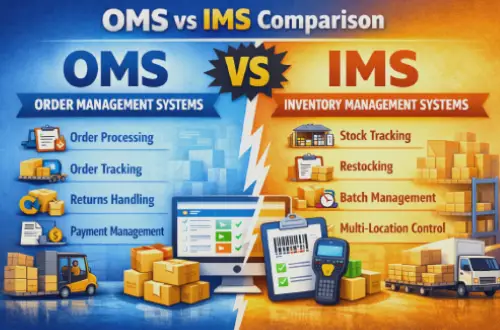
OMS (Order Management Systems) focus on order flow—capturing, processing, routing, and tracking orders.
Order Management Systems (OMS) are designed to streamline the entire order lifecycle, from placement to fulfillment and returns. They act as a central hub for processing orders across multiple sales channels (e.g., eCommerce platforms, marketplaces, brick-and-mortar stores) and ensuring timely delivery.
IMS (Inventory Management Systems) focus on stock—tracking inventory levels, movements, and replenishment.
Inventory Management Systems (IMS), on the other hand, focus on tracking and optimizing stock levels across warehouses, fulfillment centers, and retail locations. They prevent stockouts, reduce overstocking, and synchronize inventory data in real time.
Key Functions of OMS & IMS
Order Management Systems (OMS)
Multi-Channel Order Processing – Integrate orders from Amazon, Shopify, WooCommerce, and manual entries into one dashboard.
Automated Order Routing – Assign orders to the nearest warehouse or 3PL partner based on location, stock availability, or shipping costs.
Real-Time Order Tracking – Provide customers with live updates via email, SMS, or portal access.
Returns & Exchange Handling – Automate refunds, replacements, and restocking.
Payment & Invoice Integration – Sync with payment gateways like PayPal, Stripe, or Alipay for seamless transactions.
In international fulfillment, OMS plays a critical role in determining where an order should be fulfilled—whether from China, Europe, or the U.S.—based on cost, delivery time, and inventory availability.
Inventory Management Systems (IMS)
Real-Time Inventory Tracking – Monitor stock levels across global warehouses to prevent overselling.
Stock Allocation & Replenishment – Use AI-driven demand forecasting to automate restocking and balance inventory across locations.
Batch & Expiry Management – Ensure FIFO (First In, First Out) compliance for perishable goods.
Cycle Counting & Audits – Conduct regular inventory checks to minimize discrepancies.
Multi-Location Inventory Control – Manage stock distribution across regions, countries, or fulfillment centers.
In global operations, IMS ensures that the right products are stored in the right locations to reduce shipping costs and improve delivery speed.
Key differences between OMS and IMS
| Aspect | OMS (Order Management Systems) | IMS (Inventory Management Systems) |
|---|---|---|
| Core Function | Order processing & fulfillment | Inventory tracking & optimization |
| Focus | Customer orders | Stock levels |
| Data Managed | Orders, payments, shipping | SKUs, quantities, locations |
| Role in Fulfillment | Orchestrates order workflow | Ensures stock availability |
| Real-Time Updates | Order status | Inventory levels |
| Primary Users | Sales & operations teams | Warehouse & inventory managers |
Core focus: OMS manages orders; IMS manages inventory
Primary goal: OMS improves order fulfillment speed and accuracy; IMS ensures stock accuracy and availability
Data handled: OMS tracks customer orders and shipment status; IMS tracks stock levels and inventory movement
Role in fulfillment: OMS triggers fulfillment; IMS enables it by ensuring stock is available
How OMS and IMS work together
In a modern international fulfillment setup, OMS and IMS are tightly integrated.
Example workflow:
A customer places an order on your website
OMS captures and processes the order
OMS queries the IMS to check stock availability across warehouses
OMS routes the order to the best fulfillment center (based on location and cost)
Warehouse picks and ships the order
IMS updates inventory levels in real time
OMS sends tracking updates to the customer
This integration prevents overselling, reduces delays, and ensures a seamless customer experience across borders.
Why Businesses Need Both OMS & IMS
For international B2B and B2C brands, relying on just one system can lead to operational bottlenecks:
Without an OMS, businesses risk delayed fulfillment, poor customer experience, and higher shipping costs due to inefficient order routing.
Without an IMS, stockouts, overstocking, and manual inventory errors can disrupt global supply chains.
When integrated, OMS and IMS create a unified solution that:
Prevents overselling by syncing inventory data with order processing.
Ensures fast fulfillment by routing orders to the nearest warehouse with available stock.
Optimizes inventory levels by analyzing sales trends and adjusting replenishment automatically.
Industry-Specific Use Cases
eCommerce Businesses
Challenge: Managing orders across Amazon, eBay, and a Shopify store while avoiding stockouts.
Solution: OMS automates order processing; IMS provides real-time stock updates to prevent overselling.
Third-Party Logistics (3PL) Providers
Challenge: Handling high-volume fulfillment for multiple clients with varying stock needs.
Solution: OMS routes orders efficiently; IMS tracks inventory per client for accurate visibility.
Retail Chains (Omnichannel Strategy)
Challenge: Syncing online and in-store inventory for a seamless customer experience.
Solution: OMS manages orders from eCommerce and POS systems; IMS ensures inventory consistency across locations.
Enterprise Supply Chains
Challenge: Managing bulk stock movements across global warehouses.
Solution: OMS streamlines order-to-warehouse assignments; IMS monitors inventory across regions for balanced stock levels.
Why Choose Chinadivision for International Order Fulfillment?
At Chinadivision, we specialize in end-to-end international logistics, combining advanced OMS and IMS technologies with global fulfillment expertise. Our solutions:
Streamline cross-border order processing with multi-channel integration.
Optimize inventory distribution across 50+ warehouses worldwide.
Provide real-time visibility into orders, shipments, and stock levels.
Leverage AI-driven insights to reduce shipping costs and improve delivery times.
Ready to scale your international operations? Contact Chinadivision today for a free consultation on how our OMS and IMS-powered fulfillment services can transform your supply chain.
FAQs: International Order Fulfillment & Transportation Services
How can Chinadivision help reduce international shipping costs?
Our AI-powered OMS routes orders to the nearest warehouse, minimizing shipping distances and costs. We also negotiate bulk rates with top carriers like DHL and FedEx.
Can OMS and IMS be integrated?
Yes. Integration ensures real-time synchronization between orders and inventory, reducing errors and delays.
How do you handle customs and compliance for international shipments?
We manage all customs documentation, duties, and taxes to ensure smooth cross-border deliveries.
Can you integrate with my existing eCommerce platform?
Yes! Our OMS supports seamless integration with Shopify, WooCommerce, Magento, Amazon, and more.
What’s the average delivery time for international orders?
Delivery times vary by destination, but our optimized routing and carrier partnerships ensure fast, reliable shipping—typically 3-7 business days for major markets.
Chinadivision offers comprehensive international order fulfillment services, including order management, inventory management, warehousing, and shipping. Chinadivision's OMS and IMS provide real-time visibility into order status and inventory levels, reducing delays and preventing stock discrepancies. Our automated workflows and AI-driven insights optimize supply chain efficiency, ensuring fast and cost-effective international freight forwarding. Scale smarter, not harder—with Chinadivision’s global fulfillment solutions.


About the Author: Limi

Limi is a content marketing expert at ChinaDivision, helping businesses and e-commerce sellers navigate the complexities of international shipping by providing actionable tips and comprehensive guides on logistics, shipping, and cargo transportation.