

Warehouse Aisles: How to Layout and Operate for Maximum Efficiency
The optimal warehouse aisle width ranges from 5 to 12 feet, depending on your equipment and operational needs: wide aisles (10-12 feet) provide flexibility for standard forklifts; narrow aisles (8-10 feet) maximize storage density using reach trucks; and very narrow aisles (5-7 feet) can increase capacity by up to 50% using specialized equipment. A well-designed aisle layout directly impacts your picking speed, storage capacity, and order fulfillment costs.
Table of Contents
- The Role of Warehouse Aisles in Modern Logistics Distribution
- How to Determine Aisle Width and Layout?
- Calculating the Optimal Aisle Width: A Step-by-Step Guide
- What are some common warehouse aisle configurations?
- Optimizing warehouse aisles to improve order fulfillment efficiency
- Why is aisle design critical for global logistics and distribution?
- Frequently Asked Questions (FAQ)
- Choose ChinaDivision for Optimized International Fulfillment
As a professional international order fulfillment service provider, ChinaDivision understands that warehouse aisle design is the cornerstone of efficient logistics operations. Whether you manage your own warehouse or evaluate a third-party logistics (3PL) partner, understanding warehouse aisle optimization ensures your products move from shelves to shipment with the fastest speed and highest accuracy.
The Role of Warehouse Aisles in Modern Logistics Distribution
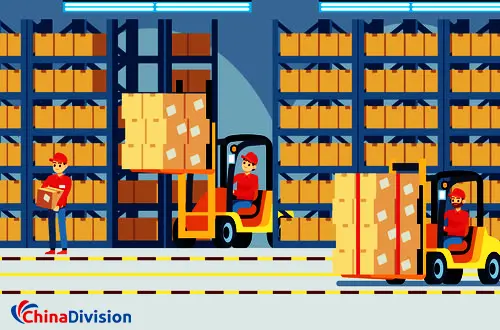
In professional order fulfillment operations, warehouse aisles are more than just passageways; they are the backbone of speed, accuracy, and scalability.
Picking Aisles: The Highway of Logistics
These are the main aisles for order picking in the warehouse. Narrower aisle widths can increase storage density, but still need to ensure smooth movement of pickers and scanning workflows.
At ChinaDivision's logistics centers, we optimize the width of picking aisles based on your product characteristics, ensuring easy access to high-turnover SKUs while maintaining the storage density required for cost control by international sellers.
Lateral Aisles: Connecting Complex Operations
These aisles connect to picking aisles, facilitating the flow of goods within the warehouse. Their wider design supports two-way traffic and reduces congestion during peak periods.
For B2B businesses handling multiple products, lateral aisles ensure seamless connections between receiving, storage, picking, and shipping areas, minimizing congestion and avoiding international shipping delays.
Temporary Storage (Stamping) Areas: Critical Buffer Zones
These areas, located near the ends of aisles, are used to temporarily store picked goods before packaging and shipping, ensuring continuous flow of goods without obstructing the aisles. A well-designed aisle layout ensures these areas do not become bottlenecks during peak international shipping periods.
For global logistics service providers like Chinadivision, optimizing these aisle types directly impacts order turnaround time, labor efficiency, and delivery accuracy.
How to Determine Aisle Width and Layout?
Designing a suitable aisle layout requires balancing several operational variables:
Equipment Requirements
Forklifts, reach trucks, and handcarts have minimum aisle width requirements. For example, standard forklifts typically require approximately 10-12 feet of aisle width.
Counter pallet trucks: Require greater width, typically 12 feet or more.
Reach trucks: Operate in 8 to 10-walkway conditions.
Very narrow aisle forklifts: Specialized equipment that can travel in narrow to extremely narrow aisles. 5.5 feet.
Calculation Tip: Always add a "safety buffer" of 6 to 12 inches to compensate for operator error and pallet overhang. The manufacturer-specified minimum turning radius should be increased by a few inches.
SKU Variety
A wide range of product sizes typically requires more flexible racking aisle layouts and slightly wider aisles.
Order Volume
High-throughput fulfillment requires wider warehouse aisles to prevent bottlenecks and allow for parallel picking.
Safety and Compliance
Warehouse aisles must meet international evacuation and accessibility safety standards.
Scalability
Modular aisle layouts ensure your warehouse can adapt to seasonal peaks and long-term growth.
These decisions are even more critical in third-party logistics (3PL) environments, as facilities must handle the diverse product characteristics of multiple customers.
Calculating the Optimal Aisle Width: A Step-by-Step Guide
There is no "one-size-fits-all" answer, but you can follow these steps:
Step 1: Calculate Space for Large Equipment
Identify your largest equipment (usually heavy-duty forklifts). Determine their dimensions and develop your warehouse aisle planning strategy accordingly.
Step 2: Allocate Operating Space
Large equipment is the baseline, but extra space ensures safe and efficient operation—this is especially important for forklifts with large turning radii.
Step 3: Allocate Space for Rack Overhang
Aisles that initially seem spacious may present problems after racking is installed. Choose pallet racking that matches your product dimensions and add 3-6 inches (approximately 7.6-15 cm) to the aisle width as a standard precaution to allow for rack overhang.
Step 4: Adjusting to Unique Layout Factors
While transport aisles and picking areas are important, workstations, mezzanines, and other facilities also influence aisle width or racking layout.
What are some common warehouse aisle configurations?
Wide Aisle (10-12 feet)
Wide aisle layouts remain the default choice for many warehouses. This configuration accommodates standard forklifts and a variety of equipment without requiring specialized training.
Advantages: Best suited for flexible operations and large-item transport.
No specialized equipment required.
Lower storage density, but easier to implement and scale.
Disadvantages: Lower storage density. Best suited for warehouses with low inventory levels, large product volumes, or unpredictable order patterns.
Narrow Aisle (8-10 feet)
Higher storage capacity with a modest investment.
Requires aerial work platforms and trained operators.
Ideal for growing e-commerce businesses.
Well-planned narrow aisle warehouses can significantly improve warehouse efficiency—especially important for international logistics operations where space costs directly impact profits.
Very narrow aisles (5-7 feet)
Maximum storage density (up to 50% increase).
Requires specialized equipment and an advanced warehouse management system.
Suitable for high-volume, standardized inventory management.
Ultra-narrow aisle VNA configurations are suitable for small-item businesses with large storage volumes, predictable order patterns, and a single product type—therefore, significant upfront investment in equipment and technology is justified.
Chinadivision frequently helps clients select appropriate configurations based on their SKU profile, shipping destinations, and growth plans.
Optimizing warehouse aisles to improve order fulfillment efficiency
Efficient warehouse aisles require continuous optimization, not just initial design.
Smart inventory layout
Utilizing ABC analysis to place fast-moving SKUs in easily accessible picking aisles reduces walking time and increases order processing speed.
Digital Integration (Scanning and RFID)
Barcode and RFID systems eliminate human error and provide real-time inventory tracking—crucial for accurate international order fulfillment.
Dynamic Aisle Reconfiguration
Adjust aisle layouts seasonally to handle peak demand (e.g., holiday peaks) and ensure unobstructed warehouse aisles.
Data-Driven Management with WMS
Advanced systems like Chinadivision's WMS utilize real-time analytics and predictive insights to optimize picking routes, reduce walking distances, and prevent aisle congestion. Chinadivision's WMS uses advanced algorithms to optimize SKU placement, reducing picker walking time by up to 40% compared to static layouts.
Why is aisle design critical for global logistics and distribution?
For cross-border e-commerce and B2B logistics, poor aisle layouts can lead to:
Slower order processing speeds
Increased labor costs
Increased picking error rates
Shipping delays
Professionally managed third-party logistics companies like Chinadivision can ensure your warehouse aisle layout is optimized for international shipping efficiency, helping you scale your business without operational bottlenecks.
Frequently Asked Questions
How can a third-party logistics (3PL) company optimize warehouse aisle layout for my business?
Professional 3PL companies analyze your SKU mix, order volume, and shipping patterns to design the most efficient shelving layout, improving picking speed and reducing costs.
What is the optimal aisle width for e-commerce logistics?
Most e-commerce operations benefit from narrow aisle layouts (8-10 feet), which balance storage density and operational efficiency.
Can a 3PL company adjust shelving aisle layouts during peak seasons?
Yes. Leading providers like Chinadivision utilize flexible shelving aisle layouts and data forecasting to dynamically reconfigure warehouse aisles.
How does warehouse aisle design affect shipping speed?
An efficient aisle layout reduces picker walking time and congestion, directly improving order processing and shipping speed.
Choose ChinaDivision for Optimized International Fulfillment
Your warehouse aisle layout directly determines your ability to compete in global e-commerce. Rather than investing capital in facility design and equipment experimentation, partner with ChinaDivision—where optimized aisle layout, advanced technology, and international logistics expertise come standard.
Our facilities feature scientifically designed shelving aisle layout configurations that maximize storage density while maintaining the picking speed your customers demand. With real-time WMS integration, scalable operations, and expertise in international compliance, we transform warehouse efficiency from a capital challenge into a competitive advantage.
Ready to optimize your fulfillment operations? Contact ChinaDivision today for a free logistics assessment and discover how professional warehouse aisle design accelerates your international growth.


About the Author: Limi

Limi is a content marketing expert at ChinaDivision, helping businesses and e-commerce sellers navigate the complexities of international shipping by providing actionable tips and comprehensive guides on logistics, shipping, and cargo transportation.