

Freight Invoice vs. Bill of Lading: What’s the Difference?
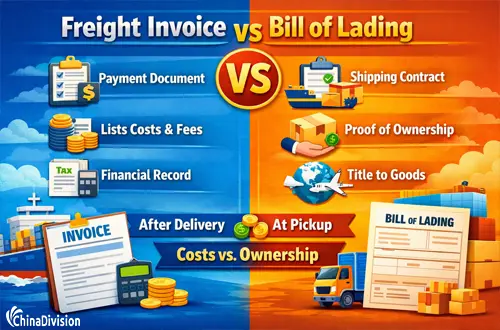
A Bill Of Lading (BOL) and a Freight Invoice serve two completely different purposes. A Bill Of Lading is a legal shipping document that confirms cargo receipt, transportation terms, and ownership of goods, while a Freight Invoice is a financial document requesting payment for freight services and related charges. The BOL tracks and authorizes the shipment, while the Freight Bill tracks and charges the shipping costs.
Table of Contents
- What Is a Bill Of Lading (BOL)?
- What Is a Freight Invoice?
- Freight Invoice vs. Bill Of Lading: Key Differences
- Why Both Documents Matter in International Shipping
- Do Freight Invoice and Bill Of Lading Information Need to Match?
- Common Causes of Freight Invoice Discrepancies
- How to Ensure Your Freight Bill & Bill of Lading Are Always Accurate
- How Chinadivision Helps Global Businesses Simplify International Shipping
- Best Practices for Managing Freight Invoice and Bill Of Lading Documents
- Frequently Asked Questions (FAQ)
- Ready to Ship Smarter with Chinadivision?
As an international order fulfillment provider that processes thousands of cross-border shipments annually, we see B2B shippers confuse these two documents constantly — and that confusion costs money. This guide breaks down everything you need to know, from what each document must include to how to audit them for accuracy, so you can ship smarter and avoid costly delays.
What Is a Bill Of Lading (BOL)?
A Bill of Lading (BOL) is one of the most critical documents in international freight shipping. Issued by the carrier (or your freight forwarder) the moment goods are accepted for transport, it legally binds all parties — the shipper, carrier, and consignee — and provides transparency for customs clearance, insurance claims, and ownership transfer.
In international shipping, the BOL often doubles as a customs declaration document, making its accuracy non-negotiable. A single error in the BOL can trigger customs holds, re-inspection fees, or even cargo seizure.
The BOL acts as:
A receipt confirming the carrier received the goods
A contract of carriage between shipper and carrier
A document of title proving ownership of cargo
A shipment tracking and customs reference document
In international freight forwarding, the Bill Of Lading is often required for customs clearance, cargo release, insurance claims, and international trade compliance.
What Should a Bill Of Lading Include?
| Field | Why It Matters |
|---|---|
| Shipping/Purchase Order Numbers | Links the shipment to your ERP or order management system |
| Pickup & Delivery Addresses + Special Instructions | Prevents misrouting, especially for international last-mile delivery |
| Consigner & Consignee Names + Contact Info | Required for customs and carrier communication |
| Accurate Freight Description (What? How big? How heavy?) | Critical for NMFC classification and avoiding costly re-measures |
| Packing Equipment Used (pallets, containers, etc.) | Needed for damage claims and customs valuation |
| Correct NMFC Code | Avoids re-weighs and re-classification fees — a top source of billing disputes |
| Billing Address | Often your business address; must match your accounts payable records |
| Hazmat Designation (if applicable) | Legally required for dangerous goods; missing this = customs hold |
For international shipments, even minor errors in the Bill Of Lading can lead to customs inspections, delayed delivery, detention fees, or cargo holds.
Pro Tip from Chinadivision: In cross-border fulfillment, we always validate BOL data against the commercial invoice and packing list before cargo leaves our warehouse. This single step has reduced our clients' customs delays by over 40%.
What Is a Freight Invoice?
A Freight Invoice — also known as a Freight Bill, shipping invoice, or commercial invoice (in international trade contexts) — is a detailed bill issued by the carrier or your 3PL/fulfillment partner to the shipper (consignor) that breaks down all transportation costs, including:
Base shipping rates
Fuel surcharges
Accessorial charges (liftgate, inside delivery, residential fees, etc.)
Duties and taxes (in international shipping)
Payment terms and due dates
Unlike the BOL, the Freight Invoice is purely a financial document — it doesn't prove ownership or authorize transport. Its job is to tell you exactly how much you owe, why you owe it, and when you need to pay.
What Should a Freight Invoice Include?
| Field | Why It Matters |
|---|---|
| Consigner & Consignee Names | Must match the BOL for audit consistency |
| Shipment Date | Needed for accounting period alignment |
| Origin & Destination Points | Validates the route charged |
| Accurate Freight Description (weight, dimensions, classification) | Ensures you're not overcharged |
| Exact Rate Assessed | Compare against your original quote or contract rate |
| Total Charges Due (including all accessorial fees) | The number you actually pay — scrutinize this |
| Final Route Taken (carriers, transfers) | Critical for international shipments with multiple legs |
| Billing Address | Must match your AP records for easy reconciliation |
For B2B companies managing large shipping volumes, Freight Invoice accuracy is critical for freight audit, budgeting, cost analysis, and logistics optimization.
Freight Invoice vs. Bill Of Lading: Key Differences
| Feature | Bill Of Lading (BOL) | Freight Invoice |
|---|---|---|
| Primary Purpose | Legal shipping and ownership document | Payment request for freight services |
| Issued By | Carrier or freight forwarder | Carrier, 3PL, or logistics provider |
| Issued When | When cargo is accepted for shipment | Usually after shipment completion |
| Legal Status | Legally binding document of title | Financial/accounting document |
| Main Focus | Cargo movement and ownership | Freight charges and payment |
| Used For | Customs clearance, cargo release, shipment tracking | Freight auditing and accounting |
| Includes Costs? | Usually limited shipping terms | Full freight costs and surcharges |
| Ownership Function | Yes | No |
The BOL creates the legal relationship between shipper and carrier and tracks the cargo. The Freight Invoice details the financial costs incurred during that relationship — base charges, fuel surcharges, accessorial fees, duties, and taxes.
They are complementary, not interchangeable. You need both for a complete, audit-ready shipment record.
Why Both Documents Matter in International Shipping
For global sellers, importers, and eCommerce businesses, both documents are equally important because they work together throughout the shipping process.
The Bill Of Lading ensures the cargo is properly documented and legally transported.
The Freight Invoice ensures the transportation charges are transparent and properly billed.
Without accurate coordination between the two documents, businesses may face:
Customs delays
Incorrect freight charges
Duplicate billing
Cargo release issues
Insurance claim problems
Inventory reconciliation errors
Freight audit disputes
This is especially important for businesses shipping internationally through multiple carriers, warehouses, fulfillment centers, and customs checkpoints.
Do Freight Invoice and Bill Of Lading Information Need to Match?
Yes — they should match closely.
Key shipment information should remain consistent across all logistics documents, including:
Product descriptions
Weight and dimensions
Number of cartons or pallets
Consignee information
Origin and destination
Shipping terms
However, a Freight Invoice may include additional charges not listed on the original BOL, such as:
Fuel surcharges
Residential delivery fees
Reweigh charges
Customs processing fees
Storage or detention fees
Remote area surcharges
Peak season surcharges
This is why businesses should always conduct a freight audit before approving payment.
Common Causes of Freight Invoice Discrepancies
Many companies are surprised when the final Freight Invoice differs from the original shipping quote.
Common reasons include:
- Incorrect Cargo Measurements
If the actual shipment weight or dimensions differ from the declared values, carriers may apply reweigh or reclassification charges.
- Accessorial Charges
Extra logistics services often create additional fees, including:
Liftgate service
Residential delivery
Appointment delivery
Customs inspections
Warehousing
Palletization
Address corrections
- Documentation Errors
Mistakes on the Bill Of Lading can create delays and additional operational costs.
- Customs Delays
International shipments may incur storage or demurrage charges if customs clearance is delayed.
How to Ensure Your Freight Bill & Bill of Lading Are Always Accurate
Supply chains are interconnected. An error in one document cascades into delays, re-billing, customs holds, and lost margins. Here's how B2B shippers — especially those using international order fulfillment services — can eliminate document errors:
- Embrace Digitalization & Automation
Outdated manual processes and data entry are the #1 source of document errors. The right digital tools auto-generate and integrate your BOL, Freight Invoice, packing slips, and commercial invoices from a single data source.
Modern international fulfillment platforms — like Chinadivision's order management system — automatically populate shipping fields from your ERP or TMS, with instant validation and discrepancy flagging before shipments depart.
- Align Documents for Consistency
Ensure product descriptions, quantities, weights, dimensions, and addresses match exactly across all documents:
BOL ↔ Packing Slip ↔ Commercial Invoice ↔ Freight Bill
Even a small mismatch (e.g., "100 cartons" on the BOL vs. "100 cases" on the invoice) can trigger a carrier audit or customs red flag. Automated systems eliminate this risk entirely.
- Choose the Right International Order Fulfillment & Shipping Partner
This is the single most impactful decision you can make. An experienced international freight forwarding and order fulfillment partner will:
✅ Prepare accurate BOLs and Freight Invoices before cargo moves
✅ Navigate complex customs compliance rules across markets
✅ Reconcile shipping documents automatically to prevent billing disputes
✅ Provide real-time visibility so you can audit every shipment
That's exactly what Chinadivision does. As a professional international order fulfillment service provider, we handle the entire document lifecycle — from generating customs-ready BOLs to delivering audit-accurate Freight Invoices — so you can focus on growing your business, not chasing paperwork.
How Chinadivision Helps Global Businesses Simplify International Shipping
As a professional international order fulfillment and freight forwarding company, Chinadivision helps global eCommerce sellers, wholesalers, and B2B companies streamline logistics operations with accurate shipping documentation and end-to-end fulfillment support.
| What You Need | What Chinadivision Delivers |
|---|---|
| Accurate Bill of Lading for customs clearance | Auto-generated, validated BOLs aligned with commercial invoices |
| Transparent Freight Invoice with no hidden fees | Itemized Freight Bills with full accessorial breakdown |
| End-to-end international shipping visibility | Real-time tracking across all carriers and transfer points |
| Freight audit support | Document consistency checks that reduce audit disputes by up to 60% |
| Cross-border compliance (US, EU, SEA, etc.) | Local customs expertise in 20+ markets |
| Scalable fulfillment for growing B2B brands | Warehousing, picking, packing, labeling, and shipping — all integrated |
Whether you're shipping FCL, LCL, air freight, or express parcels internationally — Chinadivision ensures your BOL and Freight Invoice are right the first time, every time.
By combining fulfillment technology with professional logistics expertise, Chinadivision helps businesses reduce shipping errors, lower logistics costs, and improve global delivery performance.
Best Practices for Managing Freight Invoice and Bill Of Lading Documents
Verify Shipment Data Before Dispatch
Always confirm:
SKU quantities
Product descriptions
Packaging details
Dimensions and weight
Shipping addresses
before generating shipping documents.
Keep Digital Copies of All Documents
Store Freight Invoices, BOLs, commercial invoices, and packing lists in a centralized digital system for auditing and compliance purposes.
Audit Freight Charges Regularly
Compare carrier invoices against:
Shipping quotes
Carrier contracts
BOL information
Actual shipment details
to detect overbilling.
Work With Experienced Logistics Partners
Reliable freight forwarders and fulfillment providers reduce operational risks and improve shipping accuracy.
The difference between a Bill Of Lading and a Freight Invoice comes down to one key distinction:
The Bill Of Lading (BOL) manages the legal and logistical movement of goods.
The Freight Invoice (Freight Bill) manages the financial side of transportation.
Both documents are essential for successful international shipping operations. Businesses that properly manage these documents can reduce shipping disputes, improve customs compliance, optimize freight spending, and create a more efficient global supply chain.
For growing B2B brands and eCommerce companies, partnering with an experienced fulfillment provider like Chinadivision can simplify international logistics while improving shipping accuracy and cost control.
Frequently Asked Questions (FAQ)
Can a Bill of Lading (BOL) be used as proof of ownership for international shipments?
Yes. The BOL is a Document of Title, meaning it legally represents ownership of the goods while in transit. In international trade, the original BOL can be endorsed and transferred to a new owner — this is common in letter-of-credit (L/C) transactions. Your Freight Invoice, by contrast, cannot transfer ownership — it's purely a financial document.
Who is responsible for errors on the Freight Invoice — the shipper or the carrier?
It depends. If the error originated from incorrect data you provided (wrong weight, wrong address), you're responsible. If the carrier charged incorrectly (wrong rate, unauthorized accessorials), you can dispute it during the freight audit process. A good fulfillment partner like Chinadivision catches these errors before the invoice is even issued.
What's the difference between a Freight Invoice and a Commercial Invoice in international shipping?
A Freight Invoice (Freight Bill) bills you for transportation services (shipping costs, surcharges, fees). A Commercial Invoice is a customs document that declares the value of the goods being imported/exported for duty calculation. Both are essential for international shipments — and both should be generated accurately by your fulfillment partner.
Can I use the same BOL for multiple shipments?
No. Each BOL is unique to a specific shipment. If you're consolidating multiple orders into one shipment (common in international fulfillment), you'll still get one BOL — but it must accurately reflect all cargo, weights, and consignees. Mismatched data here causes major customs and billing issues.
Do the Freight Invoice and Bill Of Lading need to match exactly?
They should match in core shipment details (product description, weight, addresses). However, the Freight Invoice may include additional charges not listed on the BOL.
Ready to Ship Smarter with Chinadivision?
Don't let document errors eat into your margins. Whether you need a Bill of Lading that clears customs on the first try or a Freight Invoice you can trust for accurate accounting — Chinadivision's international order fulfillment and freight forwarding services have you covered.


About the Author: Limi

Limi is a content marketing expert at ChinaDivision, helping businesses and e-commerce sellers navigate the complexities of international shipping by providing actionable tips and comprehensive guides on logistics, shipping, and cargo transportation.