

Digital Supply Chain: How to Fix Visibility Gaps, Delays, and Cost Leaks in Global Logistics
If you’ve ever stayed up at 2 a.m. responding to a panicked email from your EU distributor saying their shipment is stuck at port, or spent 3 full days cross-checking 7 different spreadsheets just to confirm how many units you have across 3 overseas warehouses, you already know exactly how much traditional supply chains are holding your global business back.
Table of Contents
- Why digital supply chains matter now
- What a digital supply chain really means
- Traditional supply chains vs digital supply chains
- Moving Beyond Legacy: Traditional Supply Chains vs. Digital Networks
- Practical Benefits of Digital Supply Chain for Cross-Border B2B Businesses
- 2026 Core Trends of Digital Supply Chain in Cross-Border Logistics
- Frequently Asked Questions (FAQ)
- Industry resources worth reading
Digital supply chains help businesses replace slow, manual logistics with real-time visibility, smarter forecasting, and faster execution. For international e-commerce brands and crowdfunding creators, the warehouse isn't just a storage room—it is the heart of your customer experience. Yet, many businesses are still bleeding money through stockouts, opaque tracking, and fragmented systems. The root cause? Operating on legacy setups that cannot handle the velocity of modern global trade.
Why digital supply chains matter now
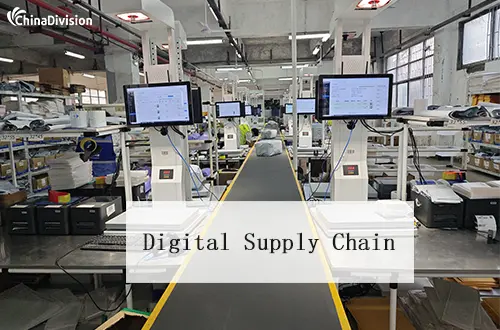
Digital supply chains are no longer a future upgrade; they are becoming the operating model for companies that need to ship faster, react sooner, and reduce fulfillment errors across borders. Traditional supply chains still rely too heavily on spreadsheets, delayed updates, and siloed communication, which creates blind spots that get expensive fast. In international warehousing and logistics, those blind spots often show up as stockouts, missed delivery windows, customs delays, and poor order visibility.
For B2B brands, the pressure is even higher because one small disruption can affect wholesale customers, retail partners, and downstream replenishment schedules at the same time. A digital logistics approach helps connect inventory, transport, warehouse operations, and order management into one more responsive system.
What a digital supply chain really means
A digital supply chain uses connected data, automation, and analytics to plan and execute logistics decisions in near real time. In practice, that means a warehouse can see inventory movement, a shipping team can respond to delays earlier, and a business can forecast demand with more confidence instead of reacting after the fact.
This is different from simply adding software. A true Digital Supply Chain works like a control system for the whole network, linking sourcing, warehousing, transportation, and customer fulfillment so decisions are based on live data rather than stale reports.
Traditional supply chains vs digital supply chains
The easiest way to understand the difference is to compare how each model handles information, speed, and exceptions.
| Area | Traditional Supply Chain | Digital Supply Chain |
|---|---|---|
| Supply Chain Visibility | Limited visibility with delayed updates and manual reporting. | Real-time, connected, and data-driven visibility across suppliers, warehouses, and transportation networks. |
| Planning & Forecasting | Planning primarily based on historical reports and manual forecasting. | Driven by real-time demand signals, predictive analytics, and AI-powered forecasting. |
| Response to Disruptions | Reactive processes with slower response times to supply chain disruptions. | Rapid rerouting, automated alerts, and agile decision-making to minimize disruptions. |
| Warehouse Operations | Manual workflows with isolated systems and limited operational visibility. | Integrated warehouse management systems (WMS), automation, barcode/RFID tracking, and measurable performance metrics. |
| Customer Experience | Less flexibility, limited shipment visibility, and fewer delivery options. | Accurate delivery ETAs, real-time order tracking, personalized fulfillment options, and enhanced customer satisfaction. |
Traditional supply chains are usually linear and sequential, which makes them vulnerable to bottlenecks and communication gaps. Digital supply chains are designed to be more agile and interconnected, which improves responsiveness when demand changes or shipments are delayed.
We saw this difference play out clearly last year for one of our electronics brand clients. When a major port strike hit the US West Coast, their old traditional supply chain setup would have left their 3 containers stuck for 3 weeks, leading to an estimated $180,000 in lost sales. With our digital supply chain system, the platform automatically identified the risk 10 days before the strike started, rerouted 2 of the containers to the East Coast port, and allocated backup local warehouse stock to cover pending orders, cutting their potential loss by 92%.
Moving Beyond Legacy: Traditional Supply Chains vs. Digital Networks
To understand the evolution, we have to look at the functional difference between supply chain and digital supply chain infrastructure.
Traditional supply chains operate linearly, resembling a rigid chain. Information moves slowly from one link to the next: the factory ships to the warehouse, the warehouse manually logs arrival, the customer places an order, and the warehouse picks it based on paper slips. If a disruption occurs at any link, the entire flow stalls because no one has real-time visibility.
Conversely, a Digital Supply Chain integrates advanced technologies—cloud platforms, AI, IoT, and real-time data analytics—into every stage of logistics. Unlike traditional supply chains, which rely heavily on manual processes and fragmented communication, digital systems create transparency, automation, and predictive capabilities across the entire network.
Key Features of Digital Logistics
- Real-time visibility: Track goods from warehouse to customer.
- Automation: Order entry, inventory updates, and shipping labels generated instantly.
- Predictive analytics: Anticipate demand and optimize inventory placement.
- Integration: Seamless connection with e-commerce platforms like Shopify and Amazon.
Practical Benefits of Digital Supply Chain for Cross-Border B2B Businesses

Many enterprises think digital transformation is a high-cost investment, but in international warehousing and order fulfillment scenarios, the short-term and long-term benefits of supply chain digital upgrading far outweigh the costs. Combined with our front-line service experience, we summarize three core practical values:
3.1 Eliminate Overseas Warehouse Inventory Blind Spots
Overseas warehousing is the core link of cross-border B2B fulfillment. Traditional supply chain models make it impossible for merchants to grasp real-time inventory of overseas warehouses, resulting in either insufficient stock to support orders or excessive inventory occupation of funds. Digital logistics system realizes real-time synchronization of global warehouse data, automatically monitors inventory changes, and triggers restocking reminders when inventory is lower than the threshold, helping enterprises achieve zero dead inventory and zero stockout.
3.2 Improve Order Fulfillment Efficiency & Reduce Error Rates
B2B bulk orders have high requirements for order accuracy and delivery timeliness. Manual processing in traditional supply chains is prone to wrong goods, missing goods and delayed delivery. The digital supply chain system realizes automatic order receiving, intelligent goods picking, batch sorting and one-click delivery. The standardized process greatly shortens the fulfillment cycle, and the error rate is reduced to almost zero, effectively improving buyer satisfaction and repurchase rate.
3.3 Realize Refined Cost Control & Risk Early Warning
Traditional supply chain cost accounting is extensive, and enterprises cannot accurately count warehousing, handling, transportation and abnormal loss costs. Supply chain digital transformation realizes full-link cost data statistics and analysis, helps merchants optimize logistics schemes, cut redundant links. Meanwhile, the system can early warn of customs clearance risks, logistics delays and inventory expiration risks, avoiding huge economic losses caused by information lag.
2026 Core Trends of Digital Supply Chain in Cross-Border Logistics
With the continuous upgrading of global cross-border trade rules and consumer demand, digital supply chain and digital logistics are showing three obvious development trends, which are also the key directions for B2B enterprises to layout logistics capabilities in 2026:
Trend 1: Full-link intelligent collaboration.
The future supply chain will no longer be the independent operation of warehousing, logistics and order links. Through digital system interconnection, suppliers, merchants, overseas warehouses and logistics carriers realize real-time data collaboration, breaking industry information barriers.
Trend 2: Customized digital fulfillment for B2B scenarios.
Most public digital logistics systems are oriented to retail e-commerce. Professional B2B digital supply chain services will focus on bulk order fulfillment, batch inventory management and long-term overseas warehousing needs, providing more matched customized solutions.
Trend 3: Risk visualization and intelligent decision-making.
Relying on big data analysis, the digital supply chain system can predict market demand changes, logistics price fluctuations and policy risks, helping enterprises make proactive operational decisions instead of passive coping.
As a professional international order fulfillment and warehousing logistics service provider, Chinadivision deeply integrates digital supply chain and digital logistics technology into every link of overseas warehousing, order processing and global delivery, solving the core pain points of traditional supply chains for B2B users.
We build a full-process digital supply chain service system: real-time visual management of global overseas warehouses, intelligent batch order fulfillment, automatic inventory early warning, full-link logistics tracking and refined cost settlement. Compared with traditional supply chain services, our digital solution helps B2B customersreduce comprehensive logistics costs by 20%–30%, shorten order fulfillment cycle by 40%, and eliminate inventory and delivery abnormal risks.
Whether you need long-term overseas goods storage, bulk B2B order fulfillment, global distribution or customized supply chain digital solutions, Chinadivision can provide one-stop professional services to help cross-border enterprises get rid of the constraints of traditional supply chains and achieve efficient and low-cost global layout.
Frequently Asked Questions
What is the difference between traditional supply chains and digital supply chains?
Traditional supply chains rely on manual processes, while digital supply chains use automation and real-time data for efficiency.
How can digital logistics reduce costs?
By optimizing routes, automating order processing, and reducing errors, digital logistics lowers operational expenses.
Can Chinadivision integrate with my e-commerce store?
Yes, Chinadivision integrates seamlessly with Shopify, Amazon, and other platforms for automated order fulfillment.
Does Chinadivision offer international warehousing?
Yes, with warehouses in Shenzhen and Yiwu, Chinadivision provides global storage and distribution solutions.
Is supply chain digital transformation only suitable for large cross-border enterprises?
No. Small and medium-sized B2B merchants are more suitable for adopting professional digital supply chain logistics services. Independent digital system construction is costly, while cooperating with professional providers like Chinadivision can enjoy mature digital logistics capabilities at low cost, avoiding the operational risks of traditional supply chains without heavy asset investment.
Industry resources worth reading
APU: Digital Supply Chain Management: 7 Essential Elements
Traditional and Digital Supply Chains A Comparative Analysis


About the Author: Limi

Limi is a content marketing expert at ChinaDivision, helping businesses and e-commerce sellers navigate the complexities of international shipping by providing actionable tips and comprehensive guides on logistics, shipping, and cargo transportation.