

EU's New €3 Tariff: How E-commerce Sellers Can Reduce Costs
If you've spent the last 5 years building a profitable cross-border business to the EU by staying under the €150 duty-free threshold, your entire operating model is about to change. Starting July 1, 2026, the European Union will remove the €150 de minimis exemption that has protected millions of low-value parcels from customs duties, replacing it with a new €3 flat-rate tariff that applies to virtually every B2C shipment.
Table of Contents
- Decoding the €3 Tariff: It’s Per HS Code, Not Per Parcel
- What Exactly Is the EU €3 Tariff?
- Why Is the EU Introducing a €3 Tariff?
- How to Reduce the Impact of the EU's €3 Tariff?
- Hidden Costs Most Sellers Don't Expect
- Professional 3PL Strategies to Mitigate EU Tariff & Compliance Risks
- Frequently Asked Questions About the EU's €3 Tariff Changes
- Authoritative Industry Reference Links
To bridge the gap before the full roll-out of the EU Customs Data Hub in 2028, the European Commission has launched a fixed-rate customs levy of €3 per item on low-value e-commerce imports. On top of this, a proposed €2 Customs Handling Fee is anticipated to take effect in November 2026.
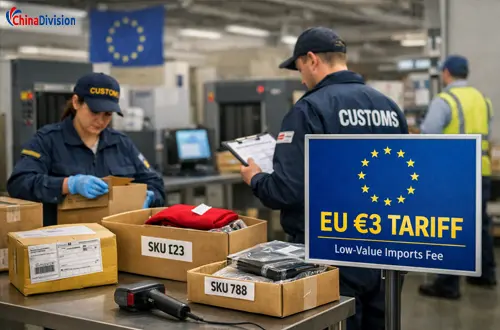
For global e-commerce brands, direct-to-consumer (DTC) sellers, and B2B exporters, these changes fundamentally rewrite the rules of international shipping, tariff collection, and margins.
Decoding the €3 Tariff: It’s Per HS Code, Not Per Parcel
| Regulation Dimension | Pre-July 2026 (Old Rule) | July 2026–July 2028 (New €3 Tariff Rule) |
|---|---|---|
| ≤ €150 Parcel Duty Treatment | Duty-free (de minimis exemption) | No exemption; fixed €3 tariff per qualifying HS code item. |
| Tariff Calculation Basis | No customs duty charged. | Charged per unique HS code item; multiple HS codes may incur multiple €3 charges. |
| VAT Rule | IOSS declaration applicable. | IOSS VAT remains unchanged; the €3 tariff is collected separately. |
| Consolidated Clearance | Available for most low-value parcels. | Significantly restricted; mixed-HS code parcels generally lose consolidated clearance eligibility. |
| Required Documents | Basic commercial invoice and declared shipment value. | Power of Attorney (POA), attestation letter, line-item HS code data, and Product Identifier (PID) from November 2026 onward. |
| Supervision Standard | Relatively low customs inspection rate. | Strict line-item verification with ongoing monthly monitoring by EU customs authorities. |
One of the most critical aspects of the new regulation is how the €3 tariff is calculated. Many merchants mistakenly assume that a single box equals a single €3 fee. In reality, the levy is charged per item classification (by its HS code) within the shipment, rather than per parcel.
A Harmonized System (HS code) is a standardized numerical method of classifying traded products. Under the new EU rules, if a parcel contains multiple items that fall under different HS code subheadings, it will incur multiple charges—even if the total intrinsic value of the entire parcel is well under €150.
The Multi-Item Penalty Example: If a customer orders 1 silk blouse and 2 wool blouses shipped in a single box, those items fall under two distinct tariff subheadings. Therefore, that single parcel will incur a €6 customs duty (€3 × 2 distinct HS codes), separate from any applicable Import One-Stop Shop (IOSS) VAT.
However, if a parcel contains three identical wool blouses (sharing the exact same HS commodity code) and the total value does not exceed €150, only a single €3 charge is applied.
What Exactly Is the EU €3 Tariff?
Official Policy Definition
The EU €3 tariff is a temporary flat-rate customs levy approved by the Council of the European Union on February 11, 2026, serving as a transitional measure before the full launch of the EU 2028 unified customs reform and Customs Data Hub. Valid from July 1, 2026, to July 1, 2028, it replaces the €150 low-value duty-free exemption for cross-border e-commerce parcels.
Unlike traditional ad valorem tariffs calculated by cargo value, this newEU tariffs rule charges a fixed €3 customs duty per unique HS code item (not per parcel), exclusively targeting low-value consignments (≤€150 intrinsic value) imported from non-EU countries.
Key Coverage Scope
- Primary applicable objects: Non-EU sellers registered under the IOSS (Import One-Stop Shop) system, covering approximately 93% of global EU-bound e-commerce imports.
- Secondary coverage: All third-country imported low-value goods entering the EU market, including B2B small-batch replenishment parcels and B2C retail orders.
- Independent charge: The €3 tariff is a standalone customs duty, completely separate from EU VAT. IOSS VAT declaration and payment processes remain unchanged.
Policy Background & Industry Purpose
The temporary levy addresses long-standing EU market imbalances: duty-free low-value parcels from overseas have squeezed local EU retailers’ profit margins and created massive customs supervision loopholes. The interim €3 tariff standardizes tariff collection for small cross-border parcels, unifies supervision standards across 27 EU member states, and buys time for the 2028 full customs system upgrade.
Why Is the EU Introducing a €3 Tariff?
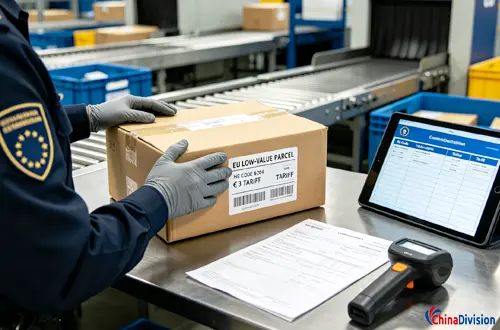
Over the past decade, Europe has experienced explosive growth in cross-border e-commerce.
Millions of e-commerce parcels now enter the EU every day from outside Europe, with the majority consisting of low-value parcels purchased through online marketplaces.
While consumers have benefited from lower prices, customs authorities have faced increasing challenges:
- Massive growth in parcel volumes
- Limited customs inspection capacity
- Inconsistent tariff collection
- Incorrect product declarations
- Undervalued shipments
- Unfair competition for EU-based retailers
The temporary €3 tariff is designed to simplify customs processing while generating additional revenue to strengthen customs enforcement until the EU's new centralized customs system becomes operational in 2028.
Instead of relying solely on complex duty calculations for every shipment, customs authorities can apply a standardized charge to qualifying imports while still requiring full customs declarations.
How to Reduce the Impact of the EU's €3 Tariff?
The introduction of the €3 tariff doesn't mean cross-border e-commerce into Europe is no longer profitable. Instead, it signals a shift toward better customs compliance, smarter fulfillment planning, and more data-driven logistics.
Businesses that adapt early can minimize additional costs, improve customs clearance efficiency, and continue delivering an excellent customer experience.
1. Build a Better HS Code Management Process
One of the biggest misconceptions about the new EU tariffs is that they simply increase shipping costs. In reality, the accuracy of your HS code data has become one of the most valuable assets in your supply chain.
Every SKU should have:
- A verified HS code
- Accurate product description
- Country of origin
- Material composition
- Declared customs value
- Product Identifier (PID) where applicable
Instead of assigning HS codes manually for every shipment, businesses should create a centralized product database that synchronizes across their ERP, warehouse management system (WMS), e-commerce platform, and shipping software.
2. Review Your IOSS Strategy
IOSS remains an effective VAT solution, but it does not eliminate the new €3 tariff, which is separate from VAT collection.
Before choosing a shipping model, evaluate:
- Annual EU sales volume
- Average order value
- Number of SKUs per parcel
- Typical destination countries
- Customer expectations
- Return rates
IOSS vs Non-IOSS Comparison
| Factor | IOSS | Non-IOSS |
|---|---|---|
| VAT Collection | Collected at checkout through the IOSS system. | Collected by customs authorities when the shipment enters the EU. |
| Customer Experience | Better checkout experience with no unexpected VAT charges upon delivery. | Customers may need to pay VAT and related charges before receiving the parcel. |
| €3 Tariff | Applies where required and is collected separately from VAT. | Also applies where required and is independent of VAT obligations. |
| Customs Clearance Speed | Generally faster due to pre-collected VAT and streamlined customs processing. | May require additional customs processing and payment before delivery. |
| Best For | High-volume B2C e-commerce sellers shipping regularly to EU consumers. | Occasional exporters, B2B shipments, or businesses without an IOSS registration. |
For many growing brands, combining IOSS with a professional fulfillment partner offers the best balance between compliance and customer satisfaction.
3. Prepare for Product Identifier (PID) Requirements
Beginning in November 2026, most B2C imports into the EU will require Product Identifiers (PIDs) at the line-item level.
Required information may include:
- Merchant Product Identifier
- Manufacturer Product Identifier
- Standardized Identifier (when available)
This represents a significant change for companies that previously relied only on SKU numbers.
Businesses should begin preparing now by improving product master data rather than waiting until enforcement begins.
4. Reduce Customs Delays Through Better Documentation
Customs authorities increasingly rely on electronic data before shipments even arrive.
Incomplete declarations can trigger:
- Manual inspection
- Customs holds
- Delivery delays
- Storage charges
- Additional administrative costs
Every shipment should include:
✓ Accurate commercial invoice
✓ Detailed packing list
✓ Correct HS code
✓ Country of origin
✓ Product description
✓ Declared customs value
✓ Product Identifier (when required)
Professional fulfillment providers verify this information before dispatch, dramatically reducing documentation errors.
5. Consider Duty & Tax Paid (DTP) Shipping
One of the biggest pain points for European consumers is receiving unexpected customs charges after placing an order.
This often leads to:
- Delivery refusal
- Negative reviews
- Chargebacks
- Customer support tickets
- Returned shipments
Using a Duty Tax Paid (DTP) model allows sellers to prepay applicable duties and taxes.
Benefits of DTP
- Better customer experience
- Higher delivery success rate
- Lower return costs
- Improved brand reputation
- Predictable landed costs
For premium brands, prepaid duties often create a smoother purchasing experience than requiring customers to pay charges at delivery.
Hidden Costs Most Sellers Don't Expect
Many businesses focus only on the visible €3 tariff.
In reality, indirect costs often exceed the tariff itself.
| Hidden Cost | Why It Happens | Potential Impact |
|---|---|---|
| Customs Delays | Incomplete or inaccurate customs documentation, missing declarations, or incorrect shipment details. | Longer delivery times, reduced customer satisfaction, and potential storage charges. |
| Customer Refusals | Unexpected duties, taxes, or handling fees requested upon delivery. | Lost sales, higher return shipping costs, and damage to brand reputation. |
| Manual Customs Inspections | Missing, inaccurate, or inconsistent HS code classifications and product information. | Additional customs clearance fees, shipment holds, and longer processing times. |
| Inventory Delays | Incomplete shipment data, inaccurate inventory records, or delayed customs release. | Stock shortages, order fulfillment delays, and reduced inventory availability. |
| Higher Customer Service Workload | Delivery disputes, customs inquiries, and unexpected import charges. | Increased operating expenses, longer response times, and reduced customer loyalty. |
Professional 3PL Strategies to Mitigate EU Tariff & Compliance Risks
Optimize HS Code Classification to Avoid Over-Charging
Provides accurateHS code classification sorting, merges eligible homogeneous item codes, avoids redundant tariff charges caused by over-classification, and ensures declaration consistency with EU customs standards to eliminate inspection risks.
Adopt DTP (Duty Tax Paid) Pre-Payment Mode
We recommend sellers switch to the DTP model to prepay all €3 tariffs, VAT, and handling fees. This zero-recipient-fee delivery model completely eliminates customer refusal risks, improves delivery success rates, and stabilizes store review ratings.
Standardize Full-Line Declaration & PID Data Sorting
We provide one-stop document customization: standardized POA, attestation letters, and full line-item shipment data sorting. We pre-build PID libraries for mainstream products to ensure full compliance with the November 2026 PID mandatory rules and zero clearance delays.
Optimize Parcel Packaging & Shipment Combination Rules
Based on order characteristics, our warehousing team optimizes parcel combination logic: consolidate single-HS-code orders to reduce tariff times, and reasonably split multi-HS-code orders to control marginal costs while complying with EU customs supervision rules.
Frequently Asked Questions About the EU's €3 Tariff Changes
Does the €3 tariff apply to B2B shipments as well as B2C?
The €3 flat-rate tariff specifically applies to B2C shipments valued at €150 or less. B2B shipments will continue under the existing duty calculation system based on HS code and value. However, B2B shipments under €150 will no longer benefit from duty-free treatment and will be subject to standard duty calculations.
Can I still use IOSS for VAT with the new €3 tariff?
Yes, IOSS (Import One-Stop Shop) for VAT collection remains separate from customs duties. You will need to handle both: IOSS for VAT and the new system for the €3 tariff. They are processed through different channels but both must be complied with.
How is the €3 levy different from VAT?
VAT is a consumption tax applied to the value of goods. The €3 levy is a customs duty, separate from VAT. Both may apply to the same shipment. VAT continues to be declared via IOSS where applicable; the €3 levy is a new, additional charge.
Why HS Code Accuracy Determines Your Logistics Costs
HS code classification is the core basis for €3 tariff collection. Inaccurate or vague HS code declarations will trigger two major risks: 1) Wrong tariff calculation leading to overpayment; 2) Customs reclassification and inspection delays, resulting in parcel detention and order cancellation losses.
Authoritative Industry Reference Links
European Commission Taxation & Customs Union – Temporary Flat Fee for Low-Value Imports (2026–2028)
European Commission – Customs Reform & E-Commerce Import Rules FAQ


About the Author: Limi

Limi is a content marketing expert at ChinaDivision, helping businesses and e-commerce sellers navigate the complexities of international shipping by providing actionable tips and comprehensive guides on logistics, shipping, and cargo transportation.