

Packing List: The Secret to Smooth Logistics and Customs Clearance
A packing slip is more than a paper insert—it is a critical fulfillment document that helps verify order accuracy, support warehouse workflows, reduce disputes, and improve international shipping compliance. It helps warehouse teams verify what was packed, what was short-shipped, and what must be tracked across inventory systems, shipping documents, and customer service workflows. In other words, the packing slip connects the physical shipment to the digital order.
Table of Contents
- Why Packing Slips Break Most Cross-Border Fulfillment
- What Is a Packing Slip? Core Definition & Industry Role
- Packing Slip vs Delivery Slip vs Shipping Slip: Clear Distinction
- Bill of Lading vs Packing Slip: Critical International Logistics Difference
- Shipping Document Comparison
- 5 Non-Negotiable Benefits of Packing Slips for Cross-Border Fulfillment
- Mandatory Elements of a Standard Packing Slip
- Platform-Specific Rules: Amazon Packing Slip vs eBay Packing Slip
- Key Best Practices for International Packing Slip Usage
- Frequently Asked Questions (FAQ)
- Helpful industry resources
Why Packing Slips Break Most Cross-Border Fulfillment
Most B2B and ecommerce sellers underestimate the power of a standard packing slip in international logistics. Many treat it as a trivial paper insert, yet inaccurate or missing packaging slip documents cause 30%+ of cross-border delivery disputes, customs clearance hold-ups, and split-shipment inventory mismatches in global order fulfillment.
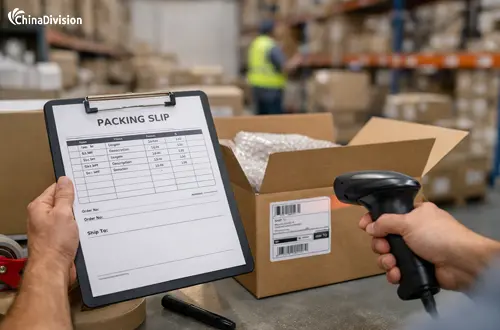
As a team that has processed over 1.2 million cross-border shipments for B2B brands in the last 5 years, we’ve seen small, avoidable mistakes on these documents cost sellers anywhere from thousands of dollars in customs fines to permanent account penalties on Amazon and eBay. Today we’re breaking down everything you actually need to know, no generic office supply advice, just real, actionable rules built for international fulfillment.
What Is a Packing Slip? Core Definition & Industry Role
A packing slip is a document that lists the items included in a shipment. It usually contains the order number, SKUs, quantities, and sometimes weights or dimensions, so the sender and receiver can confirm that the package contents match the order.
If someone asks what is a packing slip, the simplest answer is this: it is the package contents record. It is not usually a payment document, and it is not the primary customs document, but it is essential for checking fulfillment accuracy.
Unlike commercial invoices that focus on pricing and payment, a packing slip prioritizes inventory and shipment accuracy. It lists SKUs, unit quantities, package weights, dimensions, and order reference numbers, guiding warehouse packers to complete accurate packing order execution and allowing recipients to verify shipment integrity post-delivery.
Packing Slip vs Delivery Slip vs Shipping Slip: Clear Distinction
Sellers often mix up these three terms, leading to document mismatches and carrier processing errors. While they overlap in function for domestic shipping, international logistics enforces subtle but critical differences.
|
Document Type |
Core Purpose |
International Usage |
Signature Requirement |
|---|---|---|---|
|
Packing Slip / Packaging Slip |
Itemized product verification, inventory cross-check |
Mandatory for order fulfillment, internal warehouse verification |
No signature needed |
|
Delivery Slip |
Proof of successful delivery confirmation |
Used for last-mile carrier confirmation |
Requires recipient signature for official proof |
|
Shipping Slip |
Carrier transit & tracking reference |
Affixed to package exterior for carrier scanning |
No signature needed |
Key Pain Point Fix: For cross-border orders, never use a delivery slip as a replacement for a packing slip. Customs and warehouse teams rely on the detailed itemized data only a standard packing slip provides.
Bill of Lading vs Packing Slip: Critical International Logistics Difference
This is the most high-stakes mix-up in global shipping. Many new cross-border sellers confuse bill of lading vs packing slip, resulting in customs delays and cargo release failures.
|
Comparison Dimension |
Packing Slip |
Bill of Lading (B/L) |
|---|---|---|
|
Document Nature |
Fulfillment verification document |
Legal carrier contract & cargo ownership document |
|
Issued By |
Seller/fulfillment warehouse |
Ocean/air freight carrier |
|
Core Content |
SKUs, quantities, package specs, order details |
Vessel/flight info, freight terms, cargo weight, consignee details |
|
Customs Role |
Supports value estimation & item verification |
Required for cargo clearance and goods release |
|
Legal Status |
Internal/recipient reference (non-legal) |
Legally binding transport contract |
Industry Insight: Per international customs regulations, a packing slip cannot replace a bill of lading for freight clearance, but a complete packing list for customs can speed up inspection and reduce random cargo checks.
For cross-border shipments, you need both. A packing list for customs is not a replacement for a commercial invoice or bill of lading, but it is the fastest reference document that customs officers will use to do a quick spot check before they even pull up your formal declaration. If your packing slip details don’t match your customs declaration, you are 3x more likely to get your shipment pulled for a full inspection.
Shipping Document Comparison
|
Feature |
Packing Slip |
Bill of Lading (B/L) |
Delivery Note (Delivery Slip) |
Shipping Label |
Commercial Invoice |
|---|---|---|---|---|---|
|
Primary purpose |
Lists the items included in the shipment |
Serves as a transport contract, cargo receipt, and (for negotiable B/Ls) document of title |
Confirms the goods delivered to the recipient |
Identifies the shipment and enables carrier routing and tracking |
Declares the goods' value and details for customs clearance and international trade |
|
Main users |
Warehouse staff, merchant, recipient |
Carrier, shipper, consignee, customs broker |
Recipient, merchant, warehouse |
Carrier, merchant |
Merchant, buyer, customs authorities, customs broker |
|
Contains itemized product list |
✔ Yes |
✖ Generally No (cargo described at a summary level) |
✔ Usually |
✖ No |
✔ Yes |
|
Contains SKU or product codes |
✔ Usually |
✖ No |
Sometimes |
✖ No |
Sometimes |
|
Includes quantity of goods |
✔ Yes |
✔ Summary quantity (e.g., cartons, pallets, packages) |
✔ Yes |
✖ No |
✔ Yes |
|
Includes pricing or declared value |
✖ Normally No |
✖ No |
✖ No |
✖ No |
✔ Yes |
|
Used for warehouse picking & packing |
✔ Yes |
✖ No |
✖ No |
✖ No |
✖ No |
|
Used by carriers for transportation |
✖ No |
✔ Yes |
✖ No |
✔ Yes |
✖ No |
|
Used for customs clearance |
Sometimes (supporting document) |
Sometimes (shipment reference) |
✖ No |
✖ No |
✔ Primary customs document |
|
Contains consignee and shipper information |
✔ Yes |
✔ Yes |
✔ Usually |
✔ Yes |
✔ Yes |
|
Typical placement |
Inside the package (or in a document pouch) |
Accompanies freight documents (electronic or paper) |
Inside the shipment or provided upon delivery |
Affixed to the outside of the package |
Included with export/shipping documents (often in a document pouch) |
|
Required for international shipping? |
Recommended |
✔ Required for most ocean freight and many freight shipments |
Optional |
✔ Required |
✔ Required |
5 Non-Negotiable Benefits of Packing Slips for Cross-Border Fulfillment
1. Eliminate Picking & Packing Errors
Manual warehouse fulfillment is prone to SKU mix-ups and quantity errors. A standardized packing slip guides packers to verify every item before sealing packages, ensuring 100% alignment with customer packing order requirements. This is especially critical for multi-SKU international orders.
2. Organize Split International Shipments
Cross-border orders often require split shipping due to multi-warehouse inventory storage or oversized goods. A dedicated packing slip for each package lets sellers, warehouses, and overseas buyers track partial shipments accurately, avoiding missing-item disputes.
3. Accelerate Damage Claim & Refund Processing
Transit damage is common in global logistics. A signed-off packing slip serves as official proof of original shipment contents, allowing fast validation of damage claims with carriers and streamlined customer refunds or reshipments.
4. Resolve Post-Delivery Disputes Quickly
For cross-border transactions with long transit times, packing slips create a solid paper trail. If customers claim missing items, sellers can cross-check warehouse packing records and package contents to resolve disputes efficiently.
5. Support Smooth Customs Clearance
While commercial invoices are the primary customs document, a detailed packing list for customs helps customs officers verify goods descriptions, quantities, and total shipment value, reducing clearance delays and inspection risks.
Mandatory Elements of a Standard Packing Slip

A qualified sample packing slip for international shipping must include 6 core elements to meet platform and customs standards:
- Basic Order Information: Order number, PO number, order date, shipping/billing address, and contact details (critical for transit exception tracing).
- Itemized Shipment List: Full product name, SKU/UPC code, unit quantity, and individual package weight/dimensions.
- Out-of-Stock Item Notes: Clear marking of ordered but unshipped items for subsequent replenishment.
- Total Shipment Specs: Total package count, gross weight, and overall dimensions.
- Fulfillment Reference: Warehouse ID, packer ID, and shipment batch number for inventory traceability.
- Brand & Compliance Mark: Optional brand logo for unboxing experience, plus customs-friendly item descriptions.
Platform-Specific Rules: Amazon Packing Slip vs eBay Packing Slip
Ecommerce marketplaces have unique packing slip requirements that sellers must follow to avoid order penalties or listing restrictions.
Amazon Packing Slip Standards
Amazon prohibits pricing information on packing slips for FBA and self-fulfilled orders. The Amazon packing slip must only display item names, quantities, SKUs, and order numbers, ensuring customers cannot see wholesale or seller pricing. It must be placed inside every package for customer verification.
eBay Packing Slip Standards
eBay allows flexible packing slip formatting but requires clear order matching information. Sellers must include the eBay order ID and item specifics on the eBay packing slip to simplify buyer after-sales inquiries and dispute resolution.
Key Best Practices for International Packing Slip Usage
1. Placement Rule
Always insert the packing slip inside the package, not on the exterior shipping label. External labels may be damaged or replaced in transit, while internal slips ensure buyers can verify contents after opening.
2. Adopt Automated Fulfillment Processes
Manual packing slip creation and matching is the top cause of cross-border fulfillment errors. Integrated WMS systems auto-generate platform-compliant packing slips, sync order data with warehouse inventory, and verify items during packing.
3. Balance Brand Experience & Compliance
Customize packing slips with your brand logo to enhance unboxing experience, but avoid overcrowding key logistics information. Ensure compliance with Amazon/eBay no-price rules and customs clarity requirements.
4. Go Digital for Sustainability & Efficiency
For eco-friendly branding and lower logistics costs, use electronic packing slips for internal warehouse verification, while keeping a printed copy for international shipments to meet customs and buyer verification needs.
Frequently Asked Questions (FAQs) About Packing Slips & International Logistics
1. Is a packing slip mandatory for international shipping?
Yes, for formal cross-border ecommerce fulfillment. While not a legal customs mandatory document like a B/L or commercial invoice, a packing list for customs is required for item verification and reduces inspection delays.
2. Can I use the same packing slip template for Amazon and eBay orders?
No. Amazon forbids pricing data on packing slips, while eBay has no such restriction. You need customized templates for each platform to avoid compliance violations.
3. What’s the biggest difference between a bill of lading and a packing slip?
A bill of lading is a legal carrier contract for cargo ownership and transit, while a packing slip is an internal fulfillment document for item and quantity verification.
4. Where should I place the packing slip for cross-border packages?
Always place it inside the package. External shipping slips are for carrier transit, while internal packing slips serve buyer verification and customs inspection backup purposes.
5. How does a standard packing slip reduce customs clearance risks?
A detailed packing list for customs matches commercial invoice item descriptions and quantities, eliminating data mismatches that trigger customs holds and fines.
Helpful industry resources
Shopify Retail Roundup (May 2026 - v11.6 & 11.7)


About the Author: Limi

Limi is a content marketing expert at ChinaDivision, helping businesses and e-commerce sellers navigate the complexities of international shipping by providing actionable tips and comprehensive guides on logistics, shipping, and cargo transportation.