

The Impact of New EU Regulations on Low-Value Parcels on Freight Shipping
The EU’s new regulations eliminate the customs duty exemption for low-value goods, meaning all parcels—regardless of value—will face duties, stricter documentation, and tighter compliance checks. This significantly impacts international freight shipping by increasing costs, complexity, and clearance requirements for low-value e-commerce goods.
Table of Contents
- What Are the Changes in EU Tariffs?
- What Supplementary Documents Are Required for Customs Clearance?
- Impact on Freight Shipping & Fulfillment Operations
- Essential Documentation: The Compliance Wall
- Additional Documents for Special Product Categories
- Key Points for Document Compliance
- Compliance Operation Recommendations
- How Chinadivision helps you adapt?
- Frequently Asked Questions (FAQ)
For businesses shipping into the EU, this means higher compliance requirements, stricter documentation, and the elimination of simplified clearance procedures. Sellers who fail to adapt risk customs clearance delays, goods detention, and fines. Professional fulfillment providers like Chinadivision are positioned to help B2B clients navigate these changes with compliant documentation, efficient logistics, and reliable customs clearance support.
What Are the Changes in EU Tariffs?
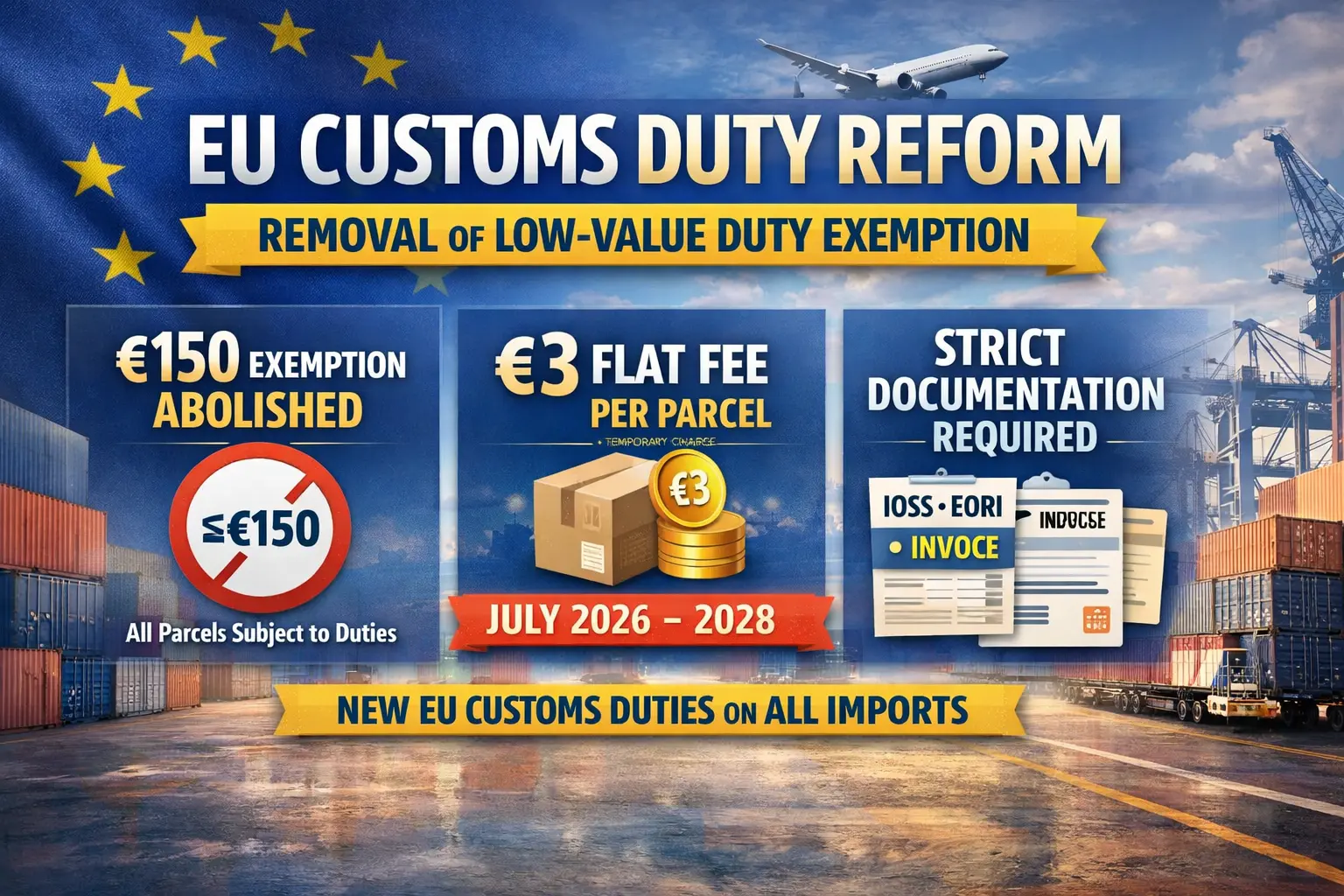
From July 1, 2026, the EU will fundamentally reshape how low-value e-commerce goods are taxed:
Key Policy Changes
Abolition of the €150 customs duty exemption
Previously, goods under €150 qualified for duty-free entry of goods. This minimum allowance is now removed.
EU introduces customs duties on all imports
Every parcel entering the EU—regardless of value—will be subject to duties.
Temporary flat-rate duty (€3 per parcel)
Applies to parcels under €150 (2026–2028)
Simplifies early-stage implementation but increases per-unit landed cost
Full tariff system by 2028
The EU will transition to standard tariff calculations via the EU Customs Data Hub, replacing the flat fee.
What This Means for Sellers?
Rising landed costs for low-value goods
Reduced pricing advantage for cross-border e-commerce sellers
Increased scrutiny on declared values (no more undervaluation or split shipments)
For businesses shipping high volumes of low-value e-commerce goods, these changes directly affect profitability, pricing strategy, and logistics planning.
What Supplementary Documents Are Required for Customs Clearance?
Under the new regulations, customs clearance for e-commerce parcels under €150 will no longer be simplified, and document requirements will be comprehensively upgraded. Small and medium-sized sellers with incomplete documentation will face customs clearance delays, goods detention, and additional fines. To ensure smooth customs clearance, sellers must complete a full set of compliance documents in advance.
Impact on Freight Shipping & Fulfillment Operations
From a professional international order fulfillment perspective, these regulatory changes will reshape the logistics landscape:
Increased Operational Complexity
Every parcel now requires full customs declaration
No simplified clearance for low-value shipments
Greater need for data accuracy and system integration
Higher Risk of Delays and Penalties
Incomplete or inconsistent documentation leads to:
Customs clearance delays
Shipment detention
Fines (30%–200% of declared value)
Cost Structure Changes
Additional duty costs + compliance overhead
Need for optimized shipping strategies (e.g., consolidation, DDP shipping models)
Stronger Compliance Requirements
Mandatory use of IOSS (B2C) or EORI (B2B)
Real-time data submission (ENS filing before arrival)
This is where experienced fulfillment providers like Chinadivision become critical—helping sellers navigate compliance while maintaining delivery efficiency.
Essential Documentation: The Compliance Wall
Under the new regulations, "simplified" no longer means "easy." Customs clearance for low-value e-commerce goods will now require a comprehensive suite of digital documents. Failure to provide these results in immediate detention, fines ranging from 30% to 200% of the value, and severe delivery delays.
1. Core Logistics Documents
Electronic Commercial Invoice: PDF versions are no longer sufficient. Data must be submitted in a structured electronic format including the HS code (6-10 digits), accurate CIF value, and detailed product descriptions (e.g., "Men's 100% Cotton T-shirts" instead of "Clothing").
Air Waybill (AWB): Must be 100% consistent with the invoice and include the IOSS number (for B2C) or EORI number (for B2B).
Entry Summary Declaration (ENS): This must be filed 24 hours in advance of the cargo's arrival in the EU.
2. Mandatory Compliance Identifiers
IOSS Registration (B2C): Sellers must have a valid IOSS number to ensure VAT is handled at the point of sale, preventing the recipient from being hit with unexpected charges.
EORI Number (B2B): Required for all non-EU sellers. From 2026, this becomes mandatory even for low-value goods.
Compliance Declarations (CE/RoHS): Necessary for electronics, toys, and lighting. Without a formal Declaration of Conformity, goods will be seized.
Additional Documents for Special Product Categories
Products with electrical components: UN38.3 report, MSDS, aviation certification.
Products with magnetic components: Magnetic detection report (≤0.159A/m at 2.1 meters).
Food/Cosmetics: Health certificate, ingredient list, safety report.
Key Points for Document Compliance
Three Documents in Accuracy: Invoice, waybill, and ENS information must match completely; product name, HS code, value, and weight must be identical.
Accurate Value Declaration: Underreporting and splitting declarations are prohibited. EU customs will conduct online verification in 2026; underreporting will result in fines of 30%-200% of the value.
IOSS/EORI Correctness: The IOSS number must be genuine and valid, and the EORI number must match the shipper's information.
Compliance Operation Recommendations
Pre-register for IOSS/EORI: Complete registration before July 2026 to avoid customs clearance issues after the new regulations take effect.
Use Standardized Document Templates: Develop standardized invoice, waybill, and ENS templates to ensure information consistency.
Choose a Compliant Freight Forwarder: Prioritize freight forwarders with EU customs clearance experience, IOSS/EORI assistance, and ENS declaration capabilities.
Under the EU's 2026 new regulations, complete documentation and compliant declaration are the only way to clear customs for low-value parcels by air. Small and medium-sized sellers must complete all required documentation, declare accurately, and choose compliant channels in advance to avoid customs delays, cargo detention, fines, and ensure stable logistics.
How Chinadivision helps you adapt?
Navigating these regulatory changes requires more than just shipping—it requires a fully integrated fulfillment and compliance strategy.
Chinadivision supports B2B clients by:
Pre-compliance checks: Ensuring all documentation meets EU standards before shipment
Accurate declaration systems: Reducing risk of fines and delays
Integrated fulfillment: Combining warehousing, order processing, and freight forwarding
Optimized shipping solutions: Selecting the best routes and methods under new cost structures
We help you maintain fast, compliant, and cost-effective delivery—even as regulations become more complex.
Frequently Asked Questions (FAQs)
What is the duty-free threshold for low-value goods in the EU?
The duty-free threshold for low-value goods in the EU will be abolished from July 1, 2026. All imports, regardless of value, will be subject to customs duties.
How can I ensure smooth customs clearance for my low-value parcels?
Ensure you have all the required documents, including an electronic commercial invoice, air waybill, and entry summary declaration. Pre-register for IOSS/EORI, use standardized document templates, and choose a compliant freight forwarder.
What are the consequences of inaccurate value declaration?
Inaccurate value declaration can result in fines of 30%-200% of the value, customs delays, and cargo detention.
Do I need an EORI number for low-value parcels?
Yes. From 2026 onwards, even low-value goods require an EORI number for customs clearance.
What documents are most critical for smooth clearance?
The invoice, waybill, and ENS declaration must match exactly. Missing or inconsistent data will result in detention.
For B2B sellers preparing for the EU’s 2026 customs reform, partnering with Chinadivision ensures compliant, efficient, and cost-effective international freight shipping. Contact us today to secure your logistics strategy before the new rules take effect.


About the Author: Limi

Limi is a content marketing expert at ChinaDivision, helping businesses and e-commerce sellers navigate the complexities of international shipping by providing actionable tips and comprehensive guides on logistics, shipping, and cargo transportation.